Repair guides
Pick a type, an appliance or a brand. Every guide lists the tools, the safety call-outs, the steps and the reading you should expect.
Diagnostic · 374
Symptom → most likely cause, step by step
Component tests · 69
How to test a specific part, with expected readings
Installation · 33
Install, replace and hook up appliances correctly
Fundamentals · 24
Core skills every appliance tech uses
Appliance
Brand-specific guides
19 guides · Water Heaters
Diagnostic · 16
 Guide · Water Heater
Anode rod: inspect and replace
The sacrificial anode protects the tank from corrosion. When it is mostly consumed (core wire exposed), replace it. Powered anodes are an option where odor is a problem.
 Guide · Water Heater
Electric water heater: no hot water
Standard residential electric tanks use two elements and two thermostats in non-simultaneous mode: the upper thermostat heats the top first, then hands power to the lower one. Totally cold water usually means a tripped high-limit (ECO), a dead upper element or a failed upper thermostat. Always find out why the ECO tripped before calling the job done.
Guide · Water HeaterGas water heater: pilot won't light or won't stay lit (diagnose and refer)
Standing-pilot gas tanks use a thermocouple or thermopile heated by the pilot to hold the gas valve open; FVIR models add a thermal switch and flame arrestor. This is a gas appliance: the tech's role here is to read the status light, confirm gas supply, note symptoms and hand off. Pilot assembly, thermocouple/thermopile, burner and gas valve work go to a licensed plumber or gas technician.
Guide · Water HeaterHeat-pump (hybrid) water heater: slow recovery, noise, errors
Hybrids need enough room air and a clean air filter, a working condensate drain and the right mode. Many complaints are mode settings or a dirty filter. Refrigerant faults are sealed-system work.
Guide · Water HeaterHot water recirculation pump problems
Check timer/settings, check valves, air in the loop and the pump itself. On tankless units with built-in pumps, a recirculation code may point to air or a leak in the loop.
Guide · Water HeaterHot water smells like rotten eggs (anode reaction)
Bacteria in some water supplies (common with wells) react with sulfates and the tank's sacrificial anode to make hydrogen sulfide. If only the hot water smells, the heater is the source. Fixes are an anode change to aluminum/zinc or a powered anode, plus a disinfecting shock; never just remove the anode.
Guide · Water HeaterRusty or brown water from hot taps only
When only the hot side is discolored, the tank is the likely source: a depleted anode rod that let the tank start corroding, rusty sediment, or (on wells) iron/manganese or iron bacteria. Check the anode before condemning the tank, but rust from an old tank lining usually means replacement.
Guide · Water HeaterT&P relief valve dripping or discharging
The T&P valve is the tank's last line of defense. It may be failing, or it may be doing its job because the house pressure is too high or thermal expansion has nowhere to go (check valve or PRV on the supply). Diagnose with a pressure gauge; replacement of the valve itself is licensed plumber work in many jurisdictions. Never cap or plug it.
Guide · Water HeaterTank water heater sediment flush
Sediment settles at the bottom, insulating gas burners and burying electric lower elements. Flush through the drain valve; heavily scaled tanks may need repeated flushes.
Guide · Water HeaterTankless water heater descaling (flush)
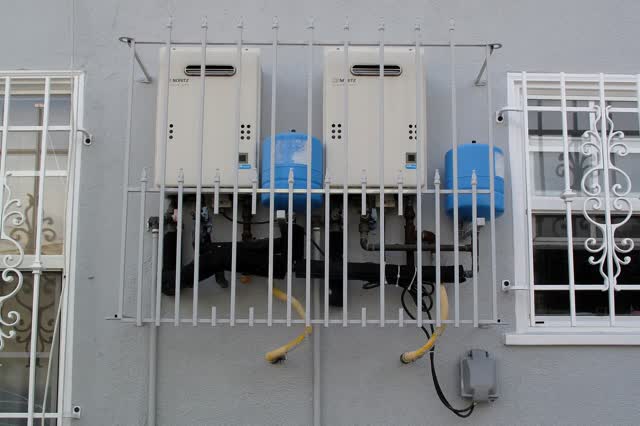
Scale insulates the heat exchanger, causing overheat codes and fluctuating temperature. Flush with a pump and descaling solution through the isolation valves.
Guide · Water HeaterTankless: error code, no ignition at low flow, or temperature swings
Many tankless complaints are water-side: flow below the activation threshold, a clogged inlet screen, low-flow aerators, or scale in the heat exchanger. Gas supply, venting and combustion codes are blocked: diagnose and refer. Read the code first, then work the water side.
Guide · Water HeaterThermal expansion tank: check and replace
On closed systems (check valve or PRV), heated water has nowhere to expand. An expansion tank absorbs it. Its air charge should match the static water pressure.
Guide · Water HeaterWater heater leaking: fitting or tank?
The key question is whether the water comes from the plumbing (repairable) or the tank itself (replace the heater). Work from the top down: supply connectors, nipples, T&P valve and its pipe, drain valve, element gaskets. Water from the bottom, under the jacket, or a rusty combustion chamber means the tank has failed.
Guide · Water HeaterWater heater noisy: popping, rumbling, crackling, humming
Rumbling and popping are usually sediment and scale at the bottom of the tank (gas) or on the elements (electric). They rarely mean the tank is failing but they cut efficiency. Banging or squealing can also come from high pressure and thermal expansion, so check pressure before blaming sediment.
Guide · Water HeaterWater heater: not enough hot water / runs out fast
On electric tanks a failed lower element or lower thermostat leaves only the top of the tank hot. Other common causes on any tank are a broken dip tube, a crossed hot/cold connection in the house plumbing, reversed connections at the heater, and simple undersizing for the demand.
Guide · Water HeaterWater heater: water too hot or ECO keeps tripping
On electric tanks overheating usually means a thermostat welded closed or not clamped tightly against the tank, or a grounded element heating outside thermostat control. On gas tanks it is a gas control fault and must be referred. Treat it as a safety call: overheated water is a scald and tank-pressure hazard.
Installation · 3
Install · Water HeaterElectric water heater replacement (permit; fill before power)
Many jurisdictions require a permit and inspection for water heater replacement, and some limit who may do it. The critical steps are a new T&P valve and correct discharge pipe, proper water connections, and filling the tank completely before power goes on: powering an empty tank burns out the element almost immediately.
Install · Water HeaterGas water heater replacement (BLOCKED: refer to a licensed plumber / gas installer)
Replacing a gas water heater involves the gas connection, flue venting and combustion air, which are licensed work. The handyman role is to assess, take immediate safety action and refer.
Install · Water HeaterThermal expansion tank install
An expansion tank absorbs the water that expands as the heater warms it. Set the tank air pre-charge to match the home static water pressure (or the PRV setting) before installing, then mount it on the cold supply to the heater and support its weight.