Repair guides
Pick a type, an appliance or a brand. Every guide lists the tools, the safety call-outs, the steps and the reading you should expect.
Diagnostic · 374
Symptom → most likely cause, step by step
Component tests · 69
How to test a specific part, with expected readings
Installation · 33
Install, replace and hook up appliances correctly
Fundamentals · 24
Core skills every appliance tech uses
Appliance
Brand-specific guides
15 guides · Furnaces
Diagnostic · 14
 Guide · Furnace
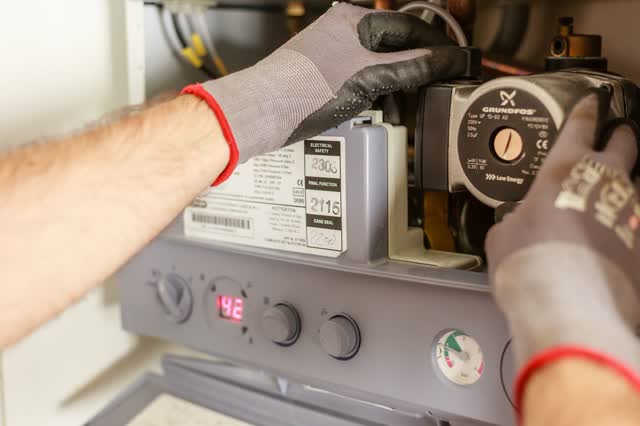
Blower runs constantly
Check the thermostat fan setting first, then whether the board is holding the blower on for a safety (open limit) or a stuck relay. On electric furnaces a stuck sequencer can do the same.
Guide · FurnaceBurners light, then shut off after a few seconds (flame sensor)
The board must prove flame by flame rectification through the flame sensor. A dirty or oxidized sensor, poor ground or reversed polarity makes the board shut the gas off right after ignition.
 Guide · Furnace
Burning smell when the heat first comes on
Dust settled on the heat exchanger or electric heat strips burns off at the first firing and fades within a few hours. A smell that lingers, or smells like plastic, rubber, hot wiring or gas, is not normal and needs diagnosis.
Guide · FurnaceCondensate trap and drain problems (90%+ furnaces)
Condensing furnaces produce acidic condensate that drains through a trap. A clogged or unprimed trap, sagging drain line, frozen line or failed condensate pump causes water backup and pressure switch trips.
 Guide · Furnace
Furnace blowing cold air on a heat call
The common causes are a fan set to ON, a dirty filter tripping the high limit so the burners stop while the blower runs, a full condensate drain on a high-efficiency furnace, or an ignition lockout. Gas valve and burner work is blocked; stop at diagnosis and refer.
Guide · FurnaceFurnace runs no heat (blower only or nothing)
Start with the board LED code, then work the call path: thermostat, 24 V, safeties, inducer, ignition, flame proving. Most no-heat calls end at a filter, a flame sensor, a pressure switch issue or gas being off.
Guide · FurnaceFurnace short cycling (starts and stops quickly)
Short cycling is usually a safety opening mid-cycle (limit from low airflow, flame sensor dropping out, pressure switch opening) or a thermostat issue. Read the code and time the cycle.
Guide · FurnaceFurnace won't turn on (no LED, nothing runs)
A dark board means no 120 V or no 24 V. Check the service switch, breaker, door switch, board fuse and transformer in that order.
Guide · FurnaceIgniter glows but burners never light
If the igniter glows and no flame appears, the problem is on the gas side (supply off, valve not opening, valve not receiving 24 V). You can confirm the gas shutoff is open and whether the board sends the valve signal; the valve and gas pressure are licensed-technician work.
Guide · FurnaceLimit trips / overheating (airflow)
The limit protects the heat exchanger from overheating. The fix is almost always airflow: filter, blower, ducts. Rollout switch trips are different and must be referred.
Guide · FurnaceNoisy furnace (squeal, rattle, roar, boom)
Mechanical noises (squeal, grind, rattle) usually come from the blower or inducer and can be checked with power off. A loud boom at ignition or roaring flame is a gas/combustion problem that must be referred.
Guide · FurnacePressure switch open / inducer problems
The pressure switch proves the inducer is moving combustion gases. It stays open when the vent/intake is blocked, the hose or port is plugged, the condensate trap backs up, or the inducer is weak.
Guide · FurnaceWhole-house humidifier leaking or running nonstop
Leaks come from a blocked drain line, loose tubing, or a scaled distribution tray. Constant water flow or too much humidity points to a setpoint that is too high, a humidistat or sensing problem, or a stuck-open valve.
Guide · FurnaceWhole-house humidifier not adding moisture
Bypass and fan-powered humidifiers need water, airflow and a call from the humidistat. Check the season damper, water valve, scaled water panel and humidistat before testing the 24 V solenoid valve.