Repair guides
Pick a type, an appliance or a brand. Every guide lists the tools, the safety call-outs, the steps and the reading you should expect.
Diagnostic · 374
Symptom → most likely cause, step by step
Component tests · 69
How to test a specific part, with expected readings
Installation · 33
Install, replace and hook up appliances correctly
Fundamentals · 24
Core skills every appliance tech uses
Appliance
Brand-specific guides
7 guides · Ranges & Ovens
Component tests · 7
 Component test · Range / Oven
Glow-bar (hot surface) oven igniter: amp draw test
In gas ovens the glow-bar igniter is wired in series with the oven safety valve. The valve opens only when enough current flows, so a weak igniter can glow and still not open the valve. Measure amps, not just glow.
 Component test · Range / Oven
How to test an infinite switch (electric surface element)
An infinite switch cycles a surface element on and off to set the heat level. Test the two line-to-element contact pairs on high and off. Also test the element itself before replacing the switch.
Component test · Range / OvenHow to test an oven bake or broil element
Bake and broil elements are 240 V resistance heaters. A good one reads somewhere in the teens to about 40 Ω depending on wattage, and never shows continuity to its metal sheath.
 Component test · Range / Oven
How to test an oven RTD temperature sensor
Most electronic ovens use a platinum RTD probe, which works the opposite way to an NTC: resistance rises with heat. Many common sensors read about 1,080 Ω at room temperature and climb roughly 2 Ω per °F.
 Component test · Range / Oven
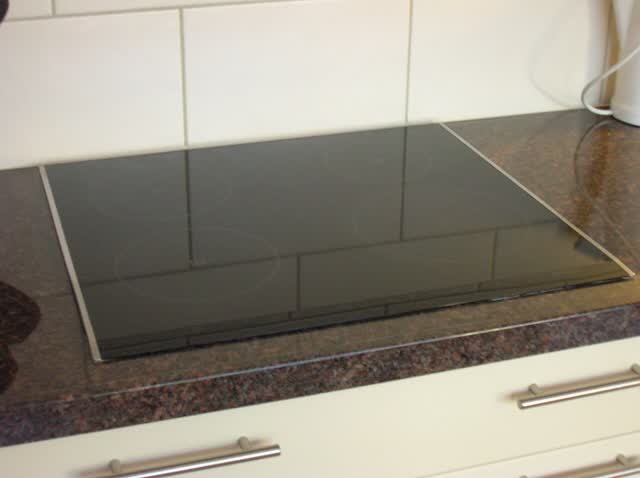
Induction coil and IGBT power board (trained techs)
Induction boards rectify line voltage to a high DC bus and switch it at high frequency through IGBT transistors into a copper coil. Field work is limited to pan check, codes, input power, coil resistance and visual inspection; board-level repair is not a field job.
 Component test · Range / Oven
Oven door lock motor and lock switches (self-clean)
Self-clean ovens use a small motor or solenoid with cam switches that tell the control the lock position. A lock stuck after self-clean is often a cooled-down timing issue; check the motor, the switches and the control output.
 Component test · Range / Oven
Spark module and electrodes (gas cooktop)
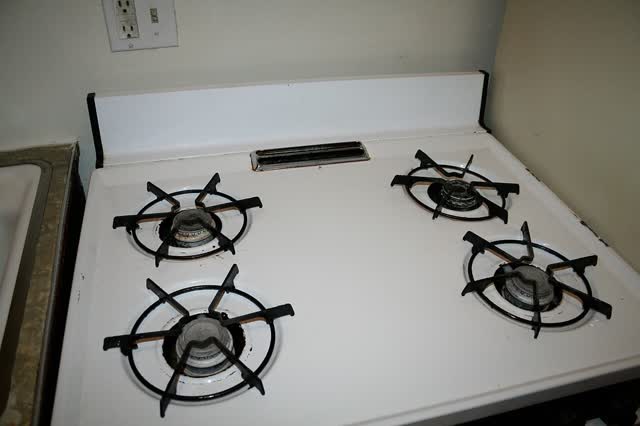
The spark module makes a high-voltage pulse when an igniter switch on a valve stem closes. Constant clicking is usually moisture or a stuck switch; no spark is a cracked electrode, bad wire, or module.