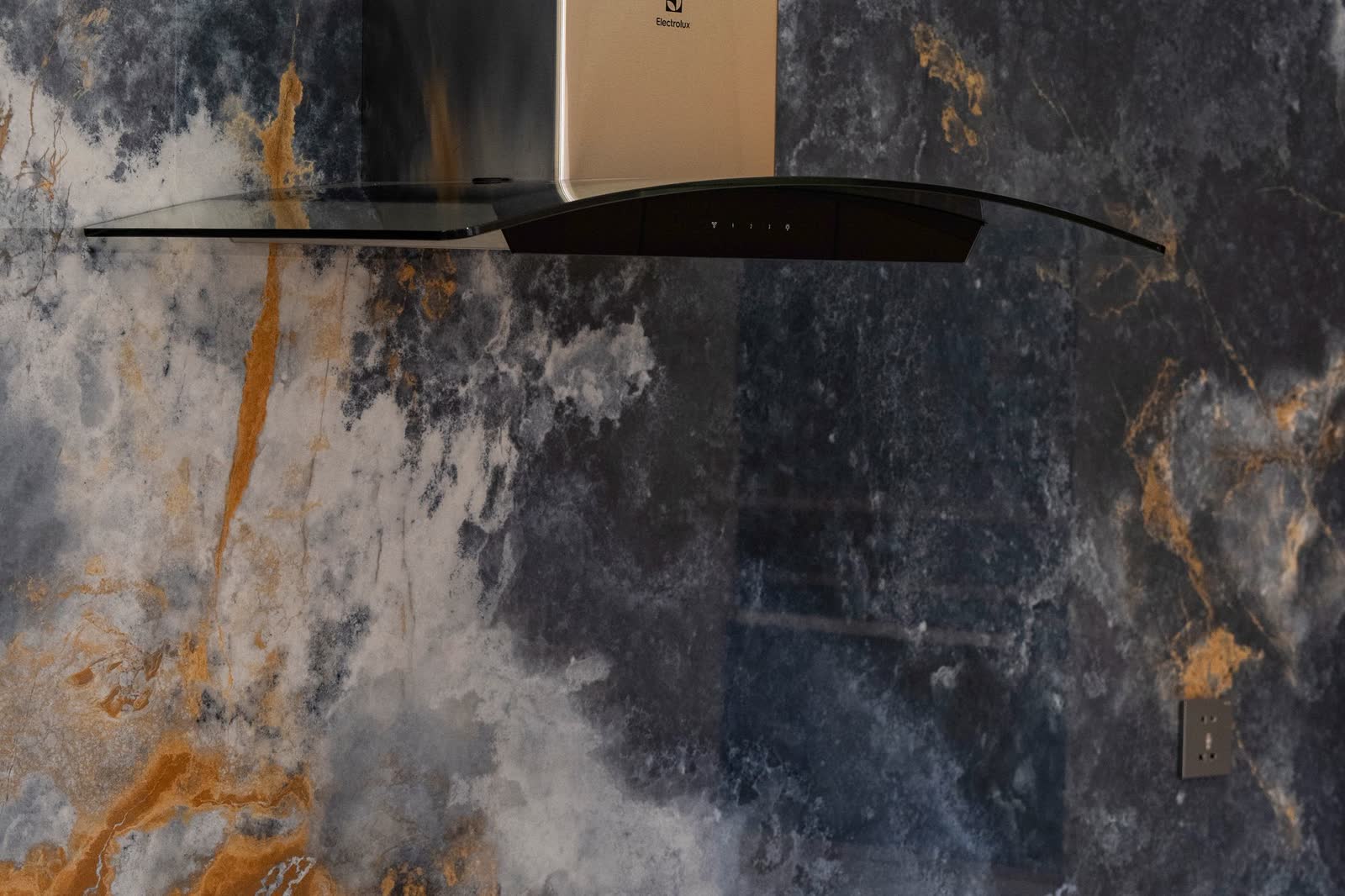
Converting a range hood to recirculating (ductless) with the maker's kit: charcoal filter, deflector and where the air goes

Most convertible hoods go ductless with a kit from the same maker: one or more charcoal (carbon) filters that sit behind or on top of the grease filter, and for chimney-style hoods an air deflector or return grille so the cleaned air blows back into the kitchen. A short duct section connects the blower outlet to that deflector. The job is mostly fit and seal; the common mistakes are using a kit for a different model, sealing the outlet with the wrong tape, and leaving too little open area for the air to come back out. Tell the customer that ductless removes grease and some odor but not heat or moisture, and that the charcoal must be replaced on a schedule.

Single source ~45 min easyBrands: Bosch, Zephyr, Vent-A-Hood, All

Before you start

  • Turn off the hood circuit at the panel before opening the hood or chimney cover; Bosch's kit sheet says to lock out the panel
  • Do not seal or block an existing exterior damper in a way that leaves an open hole in the wall or roof; cap it properly

Diagnostic steps

Unlock all 5 steps with expected values

Full library + AI assistant + the OnCall Tech app for iPhone & Android. $34.90, one time.

Get lifetime access

OnCall Tech is a reference tool for trained technicians and can make mistakes. Always disconnect power and confirm with the manufacturer's documentation before you work.
More range hoods guides

Guide · Range Hood

Water dripping from the range hood (condensation in the hood or duct, cold-weather backdraft)

Warm, humid cooking air condenses on cold hood surfaces and on ductwork running through a cold attic, wall or roof. Some condensation while boiling or steaming is normal. Steady dripping usually means weak capture or airflow (dirty filters, low speed, a stuck damper, a blocked cap), an uninsulated or too-long duct, or cold outside air leaking back in when the hood is off. Water that is clearly rain coming down the duct is a roof or cap problem.

6 steps ~45 minmoderate
Guide · Range Hood

Range hood over 400 CFM: does the job need makeup air? (IRC M1503.6 check before you sell the hood)

Under the IRC kitchen makeup-air section (M1503.6 in recent editions, M1503.4 in 2009), a hood able to exhaust more than 400 CFM needs makeup air at roughly the same rate, with at least one damper that is gravity or motorized and opens automatically when the hood runs. Recent editions apply it only when the home has a fuel-burning appliance inside the air barrier that is neither direct-vent nor mechanically drafted (e.g., a natural-draft water heater or a wood fireplace). States and cities amend this, so the local code office decides. This guide is a pre-sale and diagnosis check, not an HVAC design.

5 steps ~30 minmoderate
Guide · Range Hood

Choosing a range hood: CFM rule of thumb, hood width and mounting height

Rules of thumb used across the industry: for gas, about 100 CFM per 10,000 BTU of total burner output (total BTU divided by 100); for electric, about 100 CFM per linear foot of cooktop width (10 CFM per inch). Make the hood at least as wide as the cooktop, and wider (about 3 in each side) on gas and island installs. Mount it inside the height range in the hood's own installation instructions, because capture drops fast when a hood is mounted too high. Then check makeup air if the result is over 400 CFM.

5 steps ~20 mineasy
Converting a range hood to recirculating (ductless) with the maker's kit: charcoal filter, deflector and where the air goes · OnCall Tech